
What is an integration course for people with low literacy skills?
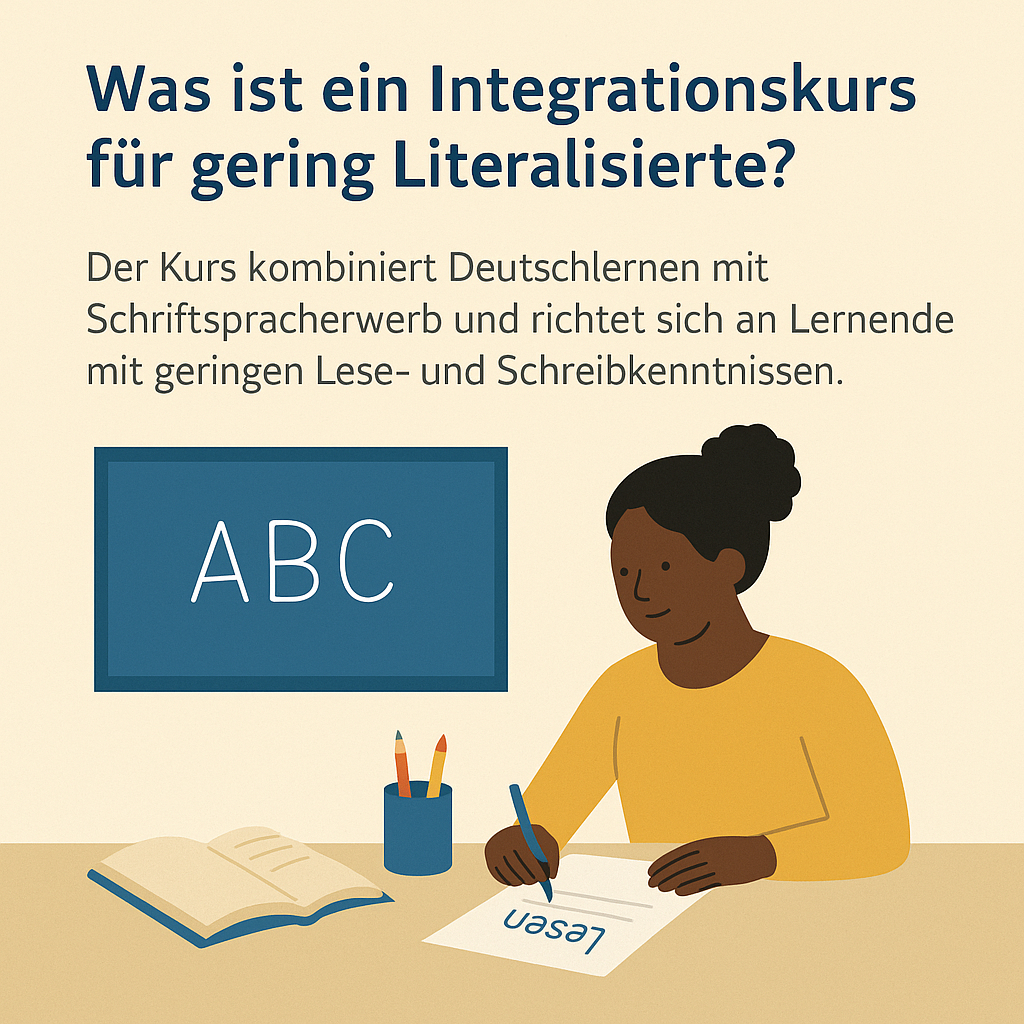
Not everyone who comes to Germany has had the opportunity to learn to read and write properly in their native language. Some can recognize individual letters, but have difficulties.. Syllables or whole words to capture. This is precisely where the new system comes into play since 2025 Integration course for people with low literacy skills an – a new BAMF course format that combines language support and literacy acquisition.
Why a special course?
Previously, participants with limited literacy skills had to attend a literacy course before they could transfer to an integration course. This separation was not always helpful – many participantsInside, they could recognize letters, but had problems with fluent reading and writing.
The new course addresses this dilemma: It is aimed at people who between a regular integration course and a literacy course – that is, learners who already have some knowledge of letters, but do not yet have sufficient reading and writing skills to follow a regular integration course.
How is the course structured?
The course includes 900 teaching units of German lessons and 100-hour orientation courseThe aim is to simultaneously develop language skills at levels A1 to A2 and strengthen reading and writing abilities. The content is strongly oriented towards the participants' everyday lives: doctor's appointments, shopping, dealing with authorities, and the workplace. Learning is structured in small steps – with plenty of repetition, visual aids, and action-oriented methods.
Who benefits from this?
The course is designed for immigrants who:
- bring basic knowledge of letters
- but are overwhelmed by syllables, word pictures or entire sentences,
- cannot read or write fluently,
- would be overwhelmed in the classic integration course,
- but not yet in need of literacy in the strict sense are.
Our assessment at tricos
From our perspective, the new course format an important step, because it targets a demographic that has often been overlooked: people with partial literacy – that is, those with skills at the letter level, but difficulties with syllables or word combinations – have not received suitable support so far.
At the same time, important questions arise for us as an educational institution:
🔸 What exactly is "Alpha 4" – and how does this new course differ from it?
The distinction from Alpha modules like Alpha 4 remains unclear, especially since similar target groups are addressed there.
🔸 Why is there no overall concept?
In addition to the new course, there are still others Literacy courses and courses for second-language learnersA coordinated structure or transition model is lacking – this can lead to unnecessary complexity and changes of course.
🔸 Why not specially trained teachers?
While additional qualifications are mandatory for literacy courses, There is currently no dedicated teacher training for the new courseWe consider this problematic, as the target group needs special didactic support – otherwise they would be well placed in the regular integration course.
Pilot course at tricos in Heilbronn
We are currently testing this new course format for the first time at our location in HeilbronnThe experiences of the first few weeks show that the need is there. Participants benefit from the slow pace, the combination of language and literacy skills – but also from the familiar learning environment with consistent mentors.
We are observing the developments critically but constructively – and are committed to long-term goals greater uniformity and quality assurance a.
Conclusion
The integration course for people with low literacy skills fills a gap – that's positive. But for it to be truly effective, it needs clear boundaries, trained teachers, and a consistent overall concept. Only then can we succeed in enabling genuine participation for all immigrants – regardless of their educational background.
Learn more now
Would you like to participate in such a course or register someone for it? We would be happy to advise you personally on course offerings, funding options, and procedures – for example, at our Heilbronn location.